Now that we know, as they didn't in the fifties, that dinosaurs like T Rex used their tails to balance when running - tails off the ground - that should change our portrayal of Godzilla. Horizontal above the legs.
Tuesday, September 03, 2013

Monday, September 02, 2013
The tumult and the shouting dies
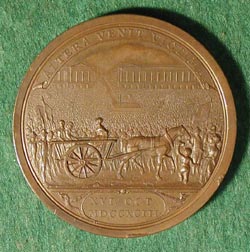
Unfortunate monarchs day at Heritage. I make a bid on Lot 62758 -
 despite the predicted sale price being between two and three times my bid; you never know....
and look longingly at
 the execution of Marie Antoinette.......

and look longingly at
Wednesday, August 28, 2013
Truth or Dare
Two medals I bid on unsuccessfully, representing the very American bombast-takedown combination.
First, a patriotic token from 1837 or 1857, with the inscription
"Millions for defence - not one cent for tribute"
 against an obverse of Liberty,

And second, a realistic reappraisal dated 1863;

"Millions for contractors -

Not one cent for the widows".
Copperhead copper, anti-Lincoln pro-slavery propaganda, but so good. And so currently applicable.
The Millions for Defence quote is linked by Wikipedia to a report on a diplomatic brouhaha between France and America caused, or at least protracted, by Talleyrand's demands for bribes. Interesting. But the slogan obviously lived on. In a time when a million dollars meant something.
First, a patriotic token from 1837 or 1857, with the inscription
"Millions for defence - not one cent for tribute"
And second, a realistic reappraisal dated 1863;
"Millions for contractors -
Not one cent for the widows".
Copperhead copper, anti-Lincoln pro-slavery propaganda, but so good. And so currently applicable.
The Millions for Defence quote is linked by Wikipedia to a report on a diplomatic brouhaha between France and America caused, or at least protracted, by Talleyrand's demands for bribes. Interesting. But the slogan obviously lived on. In a time when a million dollars meant something.
Friday, August 09, 2013
Gravity
From the Flat Earth Wiki:
You can see how that would simplify things in one way, but it does surely make it more complicated in others. Particularly when read together with
...
Each star in a cluster is attracted to one another through gravitational vectors.....
And then there's
At which point, I have to say, I'm getting a suspicion that this fellow is having a lend of me....
Gravity
Gravity is a fundamental force in Round Earth Theory and is the theoretical attraction between physical objects with mass, the force being proportional to their given mass. Many Flat Earth models omit Gravity entirely.You can see how that would simplify things in one way, but it does surely make it more complicated in others. Particularly when read together with
Stars
The sun, moon, and stars are all rotating around a central point over the North Pole. The underlying cause for this rotation is a vast cornucopia of stellar systems orbiting around its center of attraction - an imaginary point of shared attraction. This is an extrapolated and more complex binary star movement. Think of a binary (two) star system which moves around an invisible common barycenter. Now add a third body which shares that common center of attraction. Now a fourth. When we add enough bodies the system looks like a swirling multiple system....
Each star in a cluster is attracted to one another through gravitational vectors.....
And then there's
Antimoon
The Antimoon is a moon of nearly identical size to the normal moon. It is theorized that the Antimoon passes between the Earth and the Moon to account for the waxing and waning effects of the moon. The Antimoon is very dark and undetectable by any means except when it passes in front of the moon.At which point, I have to say, I'm getting a suspicion that this fellow is having a lend of me....
Tuesday, July 09, 2013
IVAN KUDOVBIN
It's a weirdly fascinating business watching sober and fair-minded
human beings trying to work out a formula for the circumstances in which
abortion should be permitted. All possible reasons and permutations of reasons
are canvassed and debated; excepting only the reason that the woman concerned
wants an abortion, which no one mentions as having any relevance to the
question at all.
Of course, this way of thinking is very congenial to a
bureaucracy-loving socialist 1ike me, who believes that people shouldn't be
allowed any freedom to choose for themselves, but should have all their
decisions made for them by faceless officials and so-called experts who think
they know what's best for everyone. But I'm rather surprised that the tireless
defenders of personal liberty whom we usually find ourselves up against in our
insidious erosion of citizen rights haven't been exposing controls and snoopers
in this sector with quite their usual vigour.
No, I was being gently ironical. I'm aware that those who
deny that a pregnant woman has any personal right to choose whether she wants
to give birth do so because they are trying to protect the right of the unborn
to be born. And there are two arguments often advanced in this direction which
I must admit I find rather compelling.
The first is that few people (if any), once having got themselves
born and in a position to say, would prefer not to have been born, however
reluctant or unsuitable their mother, or however exhausted and inadequate she
subsequently became. The second (and logically similar) argument is that if
abortion had been freely available in the past, the world might have been
deprived of individuals like Leonardo da Vinci and William the Conqueror (who
were illegitimate), and Bach (the eighth of eight children).
These arguments are good ones. The only trouble with them is
that they're too good. Take the case of that astonishing sixteenth-century
figure' Ivan Kudovbin. He invented a primitive form of gas-mantle; he wrote 123
flute sonatas, before the sonata form had been invented; he experimented with
cheap money and deficit budgeting; he raised a citizen army which drove the
Galicians right out of Galicia into Silesia, and the Silesians right out of
Silesia' into Galicia. He was undoubtedly a genius. But, as we know from
studying the history of the period, he was one of the unlucky ones who didn't
get born. He Kudovbin, but he wasn't. If he had been born he would have
preferred to have been born, I'm pretty sure, His loss is a tragedy both to
himself and to mankind.
Perhaps Kudovbin was aborted or miscarried, I’m not sure.
But I think the trouble was quite probably that he never got conceived. I don't
know what went wrong exactly. Perhaps he was the twelfth child in the family,
and his parents stopped at eleven. Perhaps his mother was a nun, under vows of
chastity. Perhaps his father was away on a business trip the night he should
have been commenced. But what seems fairly certain mathematically is that the
tragedy of his non-birth could have been averted if everyone had really taken
the matter seriously.
Think of it. If the available reproductive plant had been
fully utilised from the beginning of time, and every woman had been kept
bearing a child a year from puberty to menopause, billions upon billions more
people would have been born. Nearly all of them, once born, would have
preferred to have been born. And among them, presumably. would have been the
usual proportion of geniuses. Kudovbin after Kudovbin -- composers who wrote
greater polyphonic music than Bach; Elizabethan dramatists more universal than
Shakespeare; Elizabethan monarchs more Elizabethan than Elizabeth. .
The steamboat would have been invented in time to take
people to the Crusades; the United Nations in time to reach a negotiated settlement
instead. Frozen fish-fingers would have come in about the beginning of the
Renaissance.
Just think, for a start how many innocent babes -- potential
great men among them -- have been kept out of this world because of legal or
moral sanctions against fornication, adultery, rape, and intercourse below the
age of consent! Sentimentalists have opposed these creative and life-enhancing
activities on various short-sighted grounds, such as the well-being of the
woman concerned, and the desirability of stable family and social life. Have
they ever stopped to consider the wellbeing of poor little Vsevolod and Tatiana
Kudovbin, who as a result of their interference never even started being, well
or ill?
But then, people never stop to think about the rights of the
unborn. So-called reformers struggled for years to get slavery abolished, using
a variety of spurious moral arguments, but really on the shallow hedonistic
grounds that the slaves themselves didn't much care for it. Didn't they, indeed!
Nobody stopped to consider that without slavery there would in years to come be
no Buddy Bolden, no Jelly Roll Morton, no Blind Lemon Jefferson; hence no
syncopated popular music of any sort; hence no Beatles and no Cilla Black. So
much for Cilla Black, for all Wilberforce cared.
The simple truth is, that it's an ill wind that blows nobody
any silver linings. So carry on persecuting people; they may be Dostoyevsky.
And don't hesitate to martyr any likely-looking candidate; remember, he may not
get canonised otherwise.
Michael Frayn,
From At Bay in Gear Street, published 1967
I had occasion to quote from it recently from memory in a discussion on abortion, which is a good reason to pop it up online.
Wednesday, June 26, 2013
Zombie pyramid
In WWZ the zombies overwhelm Jerusalem by making a human pyramid up the wall.
I was starting to try and work out whether this would be possible given the compressive strength of bone - if a zombie was supporting the at least 16 layers that it would take to top the wall that would be 1,600 k on 2 sq in of femur - but on reflection the real difficulty is that the top layers aren't co-operating, they're behaving rivalrously, and if you just try and climb up each other neither of you can get high. The film's idea is that both of you as you struggle are topped by another, which might be possible if you had a genuine pyramid with a wide base but not, surely, in the upper and thinner levels.
While I'm on the film, the very extreme speed of conversion to zombie would make it almost impossible for them to get on to a plane; the film has one hiding in the toilet, but it's hard to imagine how they would have made it on the plane and into the toilet without zombifying already. Which would have slowed down the spread. Boats, too, largely. Cruise ships would be almost immune if at sea, and if in dock would be taken over and disabled.
I can't see how zombification can spread at much more than running speed.
And that Jerusalem wall - could it have been built in a few weeks? and if it was, wouldn't it be news, so that Pitt wouldn't have had to hear about it from a CIA man in Korea?
The mcguffin is that zs won't bite (or notice) people with terminal diseases because they want a fit host. In evolutionary terms, though, biting is a low-cost strategy - wouldn't you bite everything and let god sort it out? The scientist feed says yes, carrion feeders won't eat sick animals; but eating is a much higher-risk activity than biting.
The fundamental constraint is that there has to be some form of energy conversion to power their movement, and being dead it's hard to see what that is - but if you're going to have zombies, I suppose that's the one question you absolutely have to let go through to the keeper.
I was starting to try and work out whether this would be possible given the compressive strength of bone - if a zombie was supporting the at least 16 layers that it would take to top the wall that would be 1,600 k on 2 sq in of femur - but on reflection the real difficulty is that the top layers aren't co-operating, they're behaving rivalrously, and if you just try and climb up each other neither of you can get high. The film's idea is that both of you as you struggle are topped by another, which might be possible if you had a genuine pyramid with a wide base but not, surely, in the upper and thinner levels.
While I'm on the film, the very extreme speed of conversion to zombie would make it almost impossible for them to get on to a plane; the film has one hiding in the toilet, but it's hard to imagine how they would have made it on the plane and into the toilet without zombifying already. Which would have slowed down the spread. Boats, too, largely. Cruise ships would be almost immune if at sea, and if in dock would be taken over and disabled.
I can't see how zombification can spread at much more than running speed.
And that Jerusalem wall - could it have been built in a few weeks? and if it was, wouldn't it be news, so that Pitt wouldn't have had to hear about it from a CIA man in Korea?
The mcguffin is that zs won't bite (or notice) people with terminal diseases because they want a fit host. In evolutionary terms, though, biting is a low-cost strategy - wouldn't you bite everything and let god sort it out? The scientist feed says yes, carrion feeders won't eat sick animals; but eating is a much higher-risk activity than biting.
The fundamental constraint is that there has to be some form of energy conversion to power their movement, and being dead it's hard to see what that is - but if you're going to have zombies, I suppose that's the one question you absolutely have to let go through to the keeper.
Monday, June 24, 2013
and again
Straightening that out by simple extrapolation, that's this:

And if you cut back to the postwar period, all the variation (apart from that little dip in the 60s) can be covered by a thick line;

Since the war, 2.6 months a year. A year in every four and a half.

And if you cut back to the postwar period, all the variation (apart from that little dip in the 60s) can be covered by a thick line;

Since the war, 2.6 months a year. A year in every four and a half.
Subscribe to:
Posts (Atom)
Subscribe To Live Toad. Then you'll know nothing worse is going to happen to you all day.


 Posts
All Comments
Posts
All Comments